


Yes, you can fire an independent contractor, but the freedom to do so has limits. Contractors operate under agreements that outline rights, responsibilities, and exit terms. Unlike employees, they are governed by contract law, not employment law, which changes the rules of separation.
Some contracts allow termination with notice, while others require “cause,” such as breach of agreement or failure to deliver results. Ending the relationship without following the agreed process can lead to legal and financial consequences.
This matters because businesses often assume they can treat contractors like at-will employees, only to discover restrictions buried in the agreement.
The line between lawful termination and risky action lies in the details of the contract.
And that’s where the complexity begins.
Because ending a contractor relationship isn’t always as simple as saying goodbye.
Let’s get into the details.
What Makes Independent Contractors Different From Employees?
Independent contractors are service providers who work under a business contract, not an employment agreement. That distinction matters because the law sees them as running their own business, even if they work for just one client.
A quick snapshot:
This difference is what makes ending a contractor relationship more complicated than ending an employment relationship.
Legal Grounds for Ending a Contractor Agreement
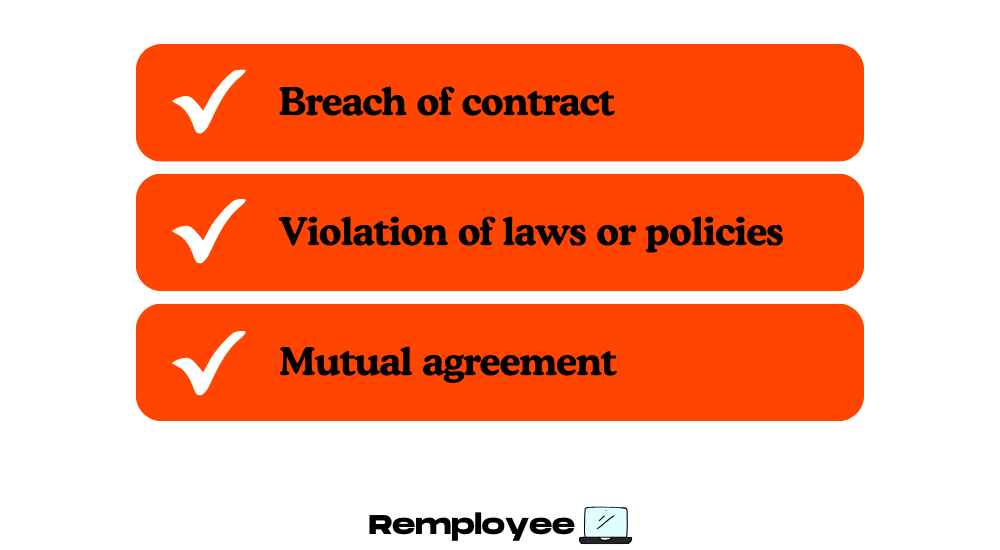
You can’t simply walk away from a signed agreement. The legal grounds for ending it usually fall into three categories:
- Breach of contract – failing to deliver agreed work.
- Violation of laws or policies – misconduct, fraud, or non-compliance.
- Mutual agreement – both sides agree to part ways.
Each ground has consequences. Breach may let you terminate immediately, but only if you can prove it. Mutual agreement avoids risk but often involves concessions.
This is where HR managers need to pay attention: the contract is your rulebook. If it doesn’t allow for certain grounds, enforcing them can backfire.
At-Will Termination: Does It Apply to Contractors?
It does not. At-will employment gives businesses wide latitude to end employee relationships without cause. Independent contractors are different. Their terms are dictated entirely by the contract both sides signed.
According to the U.S. Chamber of Commerce, 36% of the workforce is now freelancing, making clear agreements more crucial than ever (source).
If you assumed at-will status applied, you’re not alone. But contractors operate outside of those protections and obligations. Any termination that ignores the contract terms can expose your business to lawsuits, damages, or reputation harm.
So, while at-will is standard for employees, it stops at the contractor’s door.
Common Contract Clauses That Affect Termination Rights
When reviewing contractor agreements, a few clauses tend to shape your exit options the most:
- Termination for convenience – either party can end with notice.
- Termination for cause – allowed if specific conditions are met.
- Notice period – defines how much advance warning must be given.
- Dispute resolution – arbitration or mediation before legal action.
Each clause acts as a guardrail. Miss one, and you may end up breaching the agreement yourself.
This is why HR leaders should regularly review contractor contracts before engagement begins. By spotting restrictive clauses early, you prevent future disputes from escalating.
Reasons Businesses Typically End Contractor Relationships
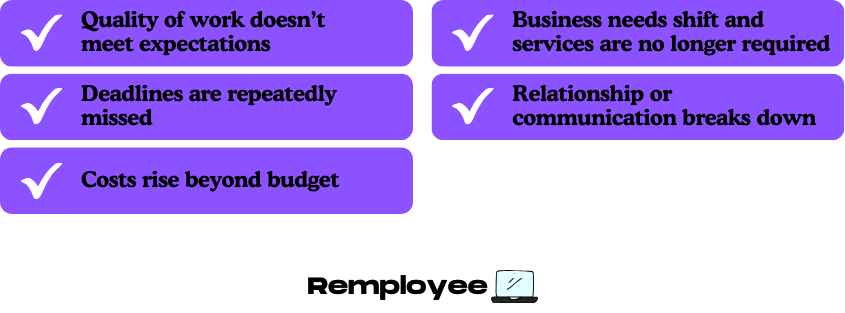
Most businesses don’t end contracts on a whim. The most common reasons look like this:
- Quality of work doesn’t meet expectations.
- Deadlines are repeatedly missed.
- Costs rise beyond budget.
- Business needs shift and services are no longer required.
- Relationship or communication breaks down.
These reasons seem straightforward, but they don’t automatically justify early termination. Even if work is disappointing, you still have to follow the written process in the agreement.
That’s why it’s vital to align expectations upfront—because ending a contract later is rarely a clean break.
Situations Where Firing an Independent Contractor May Be Risky
Ending a contract can become risky in several scenarios:
- The contract doesn’t specify clear termination rights.
- The contractor can claim damages for lost work.
- The termination could be interpreted as discrimination or retaliation.
- Confidentiality or non-compete clauses are not enforced properly.
The risk isn’t just legal—it can damage your reputation in the market. Contractors talk, and word spreads quickly about businesses that fail to honor agreements.
The safest approach is to document everything. Keep records of performance issues, communication, and attempts to resolve problems before termination. This protects your organization if disputes escalate.
Contractor Rights and Protections You Need to Know
Contractors do have protections, but they’re different from employees. They don’t receive benefits or unemployment coverage, but they are covered under contract law, intellectual property rules, and in some cases, anti-discrimination laws.
Here’s a comparison of protections:
Understanding these protections helps businesses avoid treating contractors like employees while still respecting their legal rights.
Best Practices for Ending a Contractor Agreement Legally
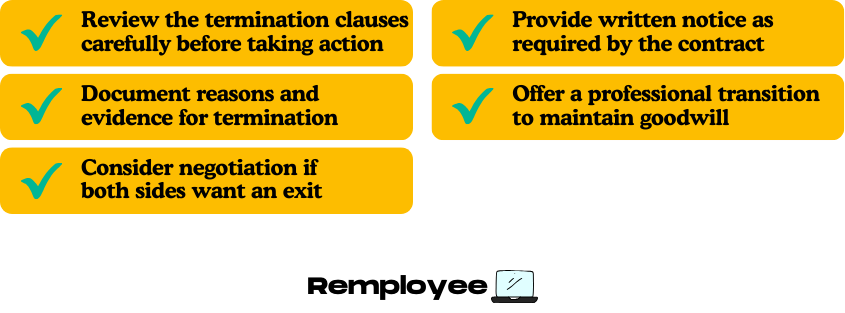
If you need to end a contract, the process matters more than the reason. Following best practices reduces the chance of disputes.
- Review the termination clauses carefully before taking action.
- Provide written notice as required by the contract.
- Document reasons and evidence for termination.
- Offer a professional transition to maintain goodwill.
- Consider negotiation if both sides want an exit.
Think of this as protecting both your brand and your bottom line. By closing the relationship with clarity and respect, you avoid unnecessary costs and preserve the option to work together again in the future.
Alternatives to Firing: Negotiation and Contract Amendments
Sometimes ending the contract isn’t the best solution. Instead, renegotiation can give both parties a path forward.
One tool that simplifies this process is HelloSign. It allows quick contract amendments, electronic signatures, and audit trails. Instead of drafting new paperwork from scratch, you can update the existing terms and finalize them securely online.
This reduces friction, saves time, and makes it easier for businesses and contractors to pivot without severing ties.
In many cases, a clear amendment—such as adjusting timelines, revising scope, or reducing hours—resolves issues without risking disputes or disrupting critical projects.
Wrap Up
Firing an independent contractor is possible, but never casual. Contracts define the rules, and ignoring them can bring financial and legal fallout. The safest route is to understand the difference between employees and contractors, document issues carefully, and follow the process outlined in the agreement.
Sometimes, renegotiation is smarter than termination. When handled with clarity and professionalism, businesses protect themselves while maintaining strong relationships with skilled contractors.

After years of freelancing through broken systems and vague job boards, Josie built Remployee to help others find what she couldn’t at first: flexible work that feels like freedom, not chaos. She believes real jobs should fit real lives—and that thoughtful writing can be a bridge to better work. If you’re looking for permission to choose differently, Josie’s already given it.