


Yes, you can work for a US company and live abroad. Two factors make it possible: modern remote work tools let teams collaborate across borders, and over 64 countries now offer digital nomad visas built for this exact setup.
Around 18.1 million Americans worked as digital nomads in 2025, and many of them earn US paychecks from overseas.
Still, the setup comes with rules.
You need the right visa, the correct worker classification, and a tax plan that covers both countries.
This article breaks down the legal side, tax rules, and practical steps to do it right.
The Short Answer to Working Abroad for a US Employer
You can work for a US company while living abroad if three things line up: your employer agrees, you hold a valid visa for the host country, and you handle taxes in both places correctly.
The catch sits in the details. Tourist stamps do not grant work rights, and misclassification can cost you and the employer real money. Around 30% of US companies have misclassified a worker at least once, so the risk is real.
Why Companies Say Yes or No to Remote Work Abroad
Employers weigh the benefits against the compliance load before approving an overseas move. Some say yes quickly. Others refuse because the paperwork grows heavy once you cross a border.
Reasons companies approve:
- Access to skilled talent already living outside the US
- Lower overhead costs when hiring through an Employer of Record
- Better retention of staff who want location flexibility
- A broader time zone coverage for customer support roles
Reasons companies refuse:
- Risk of creating a permanent establishment and triggering foreign corporate tax
- Complex payroll setups across multiple countries
- Local labor laws that may grant stronger employee rights
- Data privacy rules like GDPR that add legal exposure
How Does the IRS Tax Your Income Abroad?
The IRS taxes US citizens and green card holders on worldwide income, no matter where you live or work. That rule does not change when you move.
You file a federal return every year, report all income, and pay what you owe. Two tools lower the bill:
- Foreign Earned Income Exclusion (FEIE): Shields up to $132,900 of foreign earned income in 2026, as long as you pass the physical presence or bona fide residence test.
- Foreign Tax Credit (FTC): Offsets US tax with the tax you already paid to your host country, which helps if you live in a high-tax place.
Actionable tips to keep your tax bill clean:
- Track your days outside the US carefully. FEIE requires 330 full days abroad in any 12-month period.
- Keep pay stubs, rent receipts, and travel records in one folder.
- Hire a CPA who handles expat filings before your first April deadline.
- File an FBAR if your foreign bank accounts pass $10,000 combined at any point in the year.
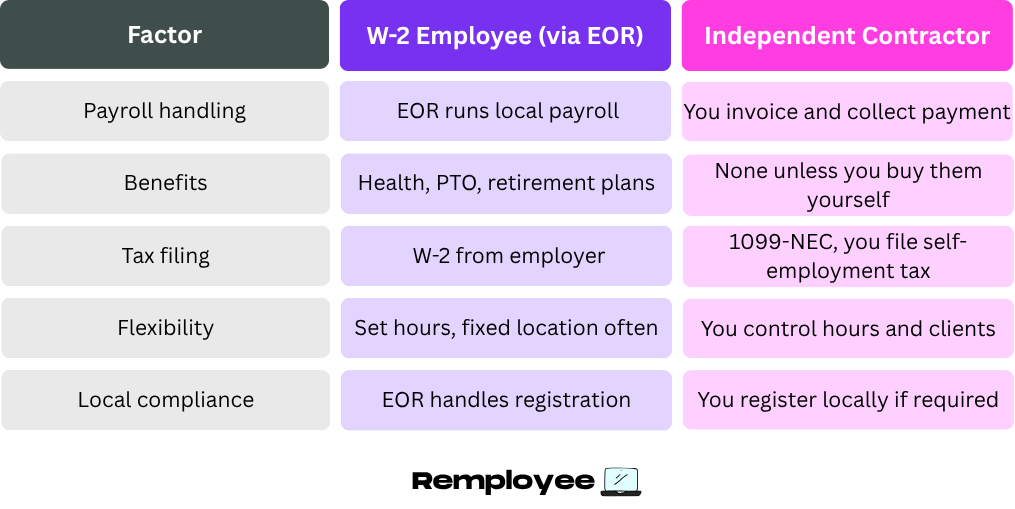
Employee vs Contractor: Which Setup Fits You?
Your classification shapes everything about payroll, benefits, and taxes. Picking the wrong one creates legal problems for both sides.
Visa Rules You Cannot Ignore
Working on a tourist visa breaks the law in most countries. Host governments can revoke your stay, fine you, or ban you from future entry.
More than 64 countries offer digital nomad visas built for remote workers earning foreign income. Spain, Portugal, Estonia, Colombia, and Thailand run some of the most practical programs.
Pick a visa that matches your plan:
- Short trip under 90 days: A tourist stamp may work, but confirm the country allows remote work on it.
- Stay of 6 to 12 months: A digital nomad visa offers legal cover and often tax perks.
- Long-term relocation: Look at residency permits or work visas tied to your employer.
Payroll and Payment Methods That Save Money
Getting paid across borders sounds simple until fees eat your paycheck. Traditional bank wires charge $25 to $50 per transfer and apply poor exchange rates.
Better options:
- Wise or Revolut: Multi-currency accounts with mid-market rates and low fees.
- Payoneer: Works well for contractors receiving US payments.
- Employer of Record services: Handle local payroll in your currency automatically.
- Starting January 2026: A 1% Federal Remittance Fee applies to outbound US transfers sent by cash or money order, so stick to ACH or digital transfers.
Common Mistakes Remote Workers Make Abroad
Small errors pile up fast when you work across borders. The same issues show up again and again.
The top mistakes to avoid:
- Assuming a tourist visa covers remote work
- Skipping FBAR filings on foreign bank accounts
- Forgetting state tax residency rules back home
- Missing the 330-day FEIE threshold by a few days
- Taking on local freelance clients, which most visas forbid
- Paying no attention to social security coverage gaps
Wrap Up
Working for a US company while living abroad is fully doable, but it takes planning on three fronts: your employer’s approval, a valid visa for your host country, and a clean tax setup in both places. Get those right and the lifestyle works. Skip one and you face fines, visa trouble, or a tax bill you did not expect.
Start the conversation with your employer early, research your destination’s visa options, and hire an expat-focused accountant before your first tax season abroad. The tools and legal paths exist. The work is in using them properly.

Alex Paun spent years as an HR director before trading boardrooms for a laptop. He now writes about remote work, hybrid teams, and workplace culture, blending insider HR experience with a practical take on how modern work actually gets done.