


💡 Quick Take: Yes, most small businesses need HR in some form. The function protects you legally, keeps employees paid correctly, and builds a workplace people want to stay in. You might handle it yourself at first. A founder managing five people can juggle payroll and hiring. But that approach breaks down as you grow. The real question becomes timing – when do you formalize HR before problems stack up?
What Does HR Actually Do in a Small Business?
HR handles everything related to your people. This covers hiring, payroll, benefits, compliance, training, and culture building. In small companies, HR often wears many hats at once.
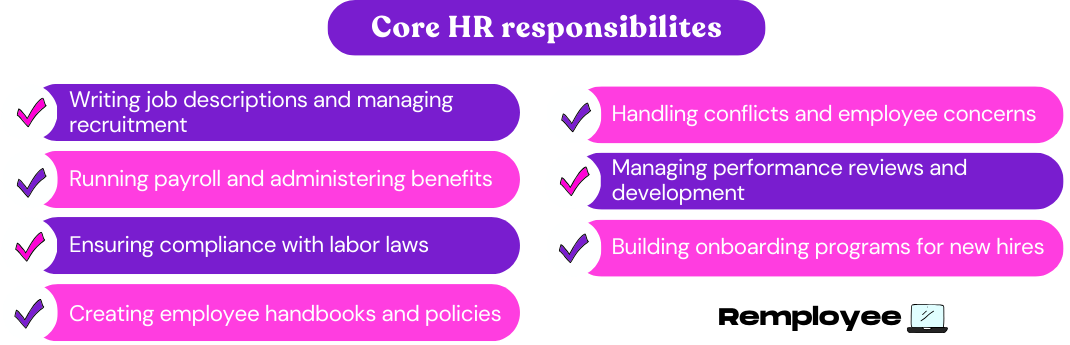
The core responsibilities include:
- Writing job descriptions and managing recruitment
- Running payroll and administering benefits
- Ensuring compliance with labor laws
- Creating employee handbooks and policies
- Handling conflicts and employee concerns
- Building onboarding programs for new hires
- Managing performance reviews and development
In larger companies, these tasks get split among specialists. In small businesses, one person might handle all of them. Sometimes that person is the owner. And that creates problems.
When Should You Stop Handling HR Yourself?
Most founders start by doing their own HR. They post jobs, run payroll, and handle paperwork between sales calls and product meetings. This works until it doesn’t.
Watch for these warning signs:
- Payroll takes hours every week instead of minutes
- You’ve missed a compliance deadline or received a warning
- Employee questions pile up in your inbox
- New hires feel lost during their first weeks
- You dread dealing with “people stuff”
- Conflicts simmer because no one addresses them
- Your best people start leaving
The average business has roughly 1.7 HR staff members per 100 employees. Expert recommendations range from 1.5 to 4.5 per 100. But these ratios matter less than your actual situation. A 15-person company with high turnover needs more HR support than a stable 30-person team.
Consider your own capacity too. If choosing between HR administration and growing the business has become a daily dilemma, that’s your signal.
Can You Legally Operate Without an HR Department?
Absolutely. No federal or state laws require businesses to have an HR department. Over 25% of Fortune 100 companies have no chief human resources officer. About 35% of startups skip HR entirely.
But legal and smart are different things. Operating without HR means someone still handles HR tasks—they’re simply doing it without training, dedicated time, or proper systems. That someone is usually you.
Half of American workers report that not having an HR department contributes to a negative workplace environment. Your employees notice when nobody handles their concerns professionally.
What Are the Real Costs of Skipping HR?
The direct costs are easy to calculate. HR software runs $3-10 per employee monthly. Outsourced HR services cost $750-3,000 monthly for startups. A full-time HR generalist costs their salary plus benefits.
The hidden costs of skipping HR hit harder:
- Compliance fines from missed regulations
- Wrongful termination lawsuits from poor documentation
- Lost productivity from disorganized onboarding
- Higher turnover from neglected employee needs
- Founder burnout from administrative overload
- Cultural problems that compound over time
One compliance violation can cost more than years of HR investment. One bad hire who should have been caught in screening can derail a small team for months.
How Does Remote Work Change HR Requirements?
Remote teams create new HR challenges that traditional approaches miss. You need policies covering work hours across time zones, equipment reimbursement, and home office safety. Tracking attendance shifts from badge swipes to outcome-based measurement.
Compliance gets complicated fast. Remote employees in different states trigger varying tax obligations and labor law requirements. California workers need different treatment than Texas workers—even on the same team.
Key remote HR priorities include:
- Clear communication policies and response time expectations
- Virtual onboarding programs that build connection
- Equipment and expense reimbursement guidelines
- Data security protocols for home networks
- Mental health support for isolated workers
HR software becomes essential for remote teams. Paper processes fail when nobody shares an office. Digital systems keep everyone connected to policies, payroll, and each other.
What HR Tools Help Manage Distributed Teams?
The right technology makes remote HR possible. Start with a solid HRIS (Human Resource Information System) that centralizes employee data, documents, and workflows in one accessible platform.
Essential tools for remote teams include:
- Cloud-based payroll that handles multi-state requirements
- Digital onboarding platforms with e-signature capability
- Time tracking software that respects autonomy while ensuring accountability
- Communication tools integrated with HR systems
- Performance management platforms for goal setting and reviews
- Employee engagement surveys to catch problems early
Video adds human connection to remote HR. Use it for interviews, onboarding sessions, and difficult conversations. Text alone misses too much nuance.
Choose tools that integrate well together. Disconnected systems create data silos and extra work. Look for platforms designed specifically for distributed workforces rather than adapted from office-based solutions.
Should You Hire In-House or Outsource?
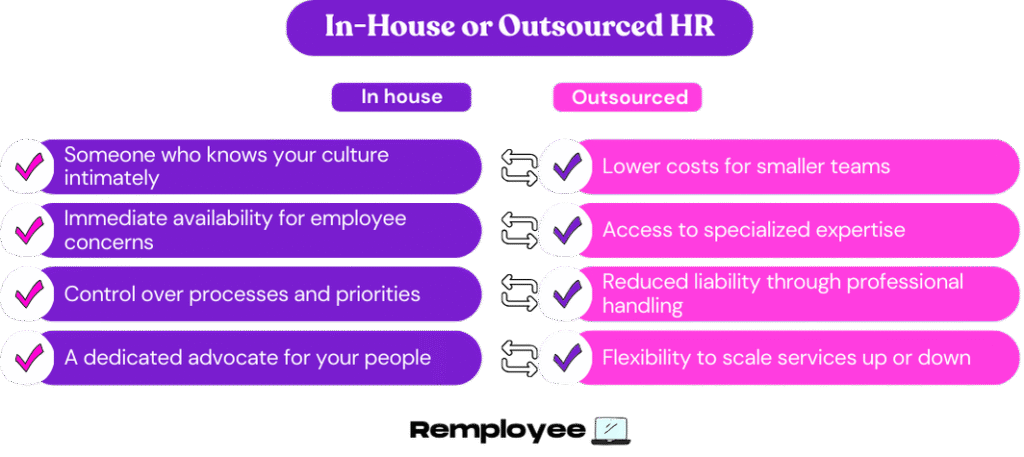
Both options work. The choice depends on your needs, budget, and company culture.
In-house HR gives you:
- Someone who knows your culture intimately
- Immediate availability for employee concerns
- Control over processes and priorities
- A dedicated advocate for your people
Outsourcing offers:
- Lower costs for smaller teams
- Access to specialized expertise
- Reduced liability through professional handling
- Flexibility to scale services up or down
About 57% of businesses outsource at least some HR tasks. Many use Professional Employer Organizations (PEOs) or Administrative Services Organizations (ASOs) for payroll, compliance, and benefits administration.
The downside of outsourcing includes less control over quality, potential communication gaps, and data security concerns. Third parties handle your sensitive employee information. That creates risk.
A hybrid approach often works best. Use software to automate routine tasks. Outsource complex compliance work. Hire in-house when you need someone deeply embedded in your culture.
What HR Functions Matter Most for Small Businesses?
Focus on the functions that protect you and support growth.
Compliance comes first. Labor laws vary by state and industry. Violations carry real penalties. Someone needs to track requirements for overtime, workplace safety, anti-discrimination, and benefits administration. This work prevents expensive problems.
Recruitment shapes your future. Bad hires cost small businesses disproportionately. When you have 10 employees, one wrong person affects 10% of your team. Good HR creates consistent hiring processes that find people who fit your culture and can grow with you.
Onboarding determines retention. The first 90 days predict long-term success. Structured onboarding makes new hires productive faster and more likely to stay. Chaotic onboarding loses you talent you worked hard to attract.
Payroll cannot fail. Employees tolerate a lot, but late or incorrect paychecks destroy trust immediately. Get this right through reliable systems, proper classification of workers, and accurate tracking.
Culture needs intentional cultivation. Without HR attention, culture forms anyway—it forms through accidents, bad habits, and whoever speaks loudest. Intentional culture building creates environments where people want to work hard and stay long.
How Does Your Industry Affect HR Needs?
Different industries create different HR demands.
Restaurants and retail face high turnover, scheduling complexity, and tip compliance issues. Healthcare businesses navigate strict credentialing and patient privacy requirements. Construction companies manage safety regulations and contractor relationships. Tech startups handle equity compensation and remote work policies.
Your industry also determines which regulations apply. Companies with 50+ employees face different rules than those with 15. Government contractors carry additional requirements. Businesses in California follow stricter labor laws than those in Texas.
Understand your specific landscape before deciding what HR support you need.
What Role Does HR Play in Scaling?
Growing from 10 to 50 employees changes everything. Processes that worked informally break down. Communication that happened naturally requires systems. Culture that felt obvious needs documentation.
HR becomes critical for scaling because:
- Hiring volume increases dramatically
- Onboarding must be repeatable and consistent
- Policies need standardization across teams
- Managers require training and support
- Compensation must stay competitive and fair
- Performance management becomes necessary
Companies planning to scale should build HR infrastructure early. Playing catch-up while growing creates chaos. Investors and acquirers also look at HR maturity. Clean employee records, proper classification, and solid policies make due diligence smoother.
How Do You Get Started With HR?
Start with an honest assessment. List every people-related task in your business. Note who handles each one and how much time it takes. Identify what’s falling through cracks.
Then prioritize:
- Immediate needs: Compliance gaps, payroll problems, urgent hiring
- Short-term improvements: Onboarding programs, employee handbook, performance tracking
- Long-term investments: Culture initiatives, development programs, strategic workforce planning
Choose your approach based on resources:
- Budget tight: Start with HR software that automates payroll and tracks compliance. Handle strategy yourself with occasional consultant help.
- Moderate resources: Combine software with outsourced compliance and benefits administration. Bring hiring and culture work in-house.
- Ready to invest: Hire an HR generalist who can own everything. Give them good tools and budget for outside expertise when needed.
Whatever approach you choose, document everything. Create templates for offer letters, termination procedures, and policy acknowledgments. Build systems that survive personnel changes.
Wrapping Up
Small businesses need HR. They may not need a full department immediately. But ignoring people management creates problems that compound over time.
The question shifts from “do we need HR” to “what HR support fits our current stage.” A five-person startup needs different solutions than a 40-person company preparing for growth.
Start where you are. Address compliance risks first. Build systems that scale. Invest in your people before they invest elsewhere.
The businesses that handle HR well attract better talent, keep employees longer, avoid costly mistakes, and build cultures worth working in. The ones that neglect it wonder why everything feels harder than it should.

After years of freelancing through broken systems and vague job boards, Josie built Remployee to help others find what she couldn’t at first: flexible work that feels like freedom, not chaos. She believes real jobs should fit real lives—and that thoughtful writing can be a bridge to better work. If you’re looking for permission to choose differently, Josie’s already given it.